
Why Professional Church Streaming Requires More Than a Camera and Microphones
Live streaming has become an important part of how churches connect with their congregations. It allows members to participate when they are sick, traveling, homebound, or otherwise unable to attend in person. It can also help a church reach new people well beyond the walls of its building.
Unfortunately, creating a professional-looking and professional-sounding stream is not as simple as purchasing a camera and a couple of microphones from a big-box store.
Consumer equipment may be adequate for video calls, home recordings, and casual content creation. A church sanctuary, however, is a much more demanding environment. Long camera distances, changing lighting conditions, highly reverberant rooms, amplified music, speech, and multiple areas of activity all have to be considered.
The result depends not only on the equipment being used, but also on how the complete system is designed, installed, configured, and operated.
Consumer Equipment Has Real Limitations
A basic camera placed at the back of a sanctuary often provides only one wide, stationary view. It may be difficult to clearly see the pastor, musicians, readers, or other participants. Digital zoom can make the image larger, but it frequently sacrifices clarity and detail.
Consumer cameras may also struggle with the lighting commonly found in churches. Bright windows, dim seating areas, spotlights, and dark backgrounds can produce washed-out faces, distracting exposure changes, or an image that never looks quite right.
Audio can be even more challenging.
Placing inexpensive microphones in the balcony may seem like a simple way to capture everything happening in the room. In a reverberant sanctuary, however, those microphones also capture reflections from the walls and ceiling, background noise, and the sound system returning through the room. Speech becomes distant and difficult to understand, while music can sound muddy and unfocused.
The online audience does not hear the service in the same way as someone sitting in the sanctuary. A proper streaming system must account for that difference.
Equipment Designed for the Application
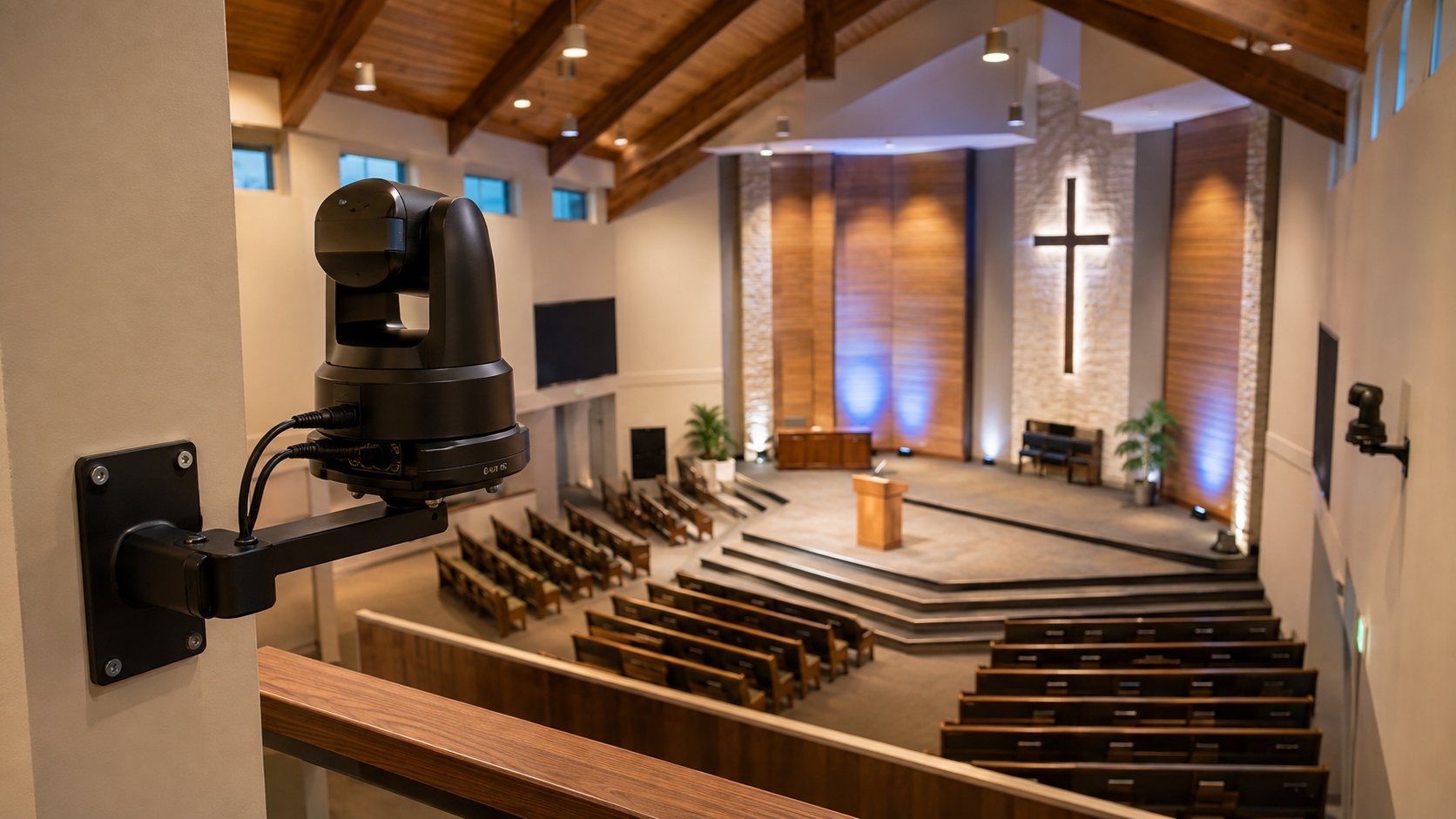
Professional PTZ cameras are built specifically for situations where a clear, flexible camera view is needed without placing a camera operator in the middle of the room.
PTZ stands for pan, tilt, and zoom. These cameras can be mounted in strategic locations and remotely moved to capture different parts of the sanctuary. Instead of being limited to one stationary shot, a church can use programmed camera positions for the pulpit, lectern, choir, musicians, baptismal area, or a wider view of the room.
For many of our church streaming systems, we recommend equipment from PTZOptics. Cleveland Sound Design is a direct PTZOptics dealer, allowing us to supply professional camera and control solutions designed for live production, worship, education, and streaming applications.
PTZOptics systems can provide churches with:
- Clear optical zoom for distant subjects
- Smooth pan and tilt movement
- Multiple programmable camera presets
- Remote camera control
- Flexible video and network connections
- Expandability for additional cameras and future upgrades
- Cleaner, more professional camera placement
The ability to recall programmed views is especially valuable. Rather than manually searching for the correct shot during every service, an operator can quickly move a camera to a carefully configured position.
The Installation Matters as Much as the Camera
Buying professional equipment is only part of the solution.
Camera locations have to be chosen carefully. Mounting height, viewing angles, lighting, cable routes, network requirements, available power, structural support, and the normal use of the sanctuary all affect the finished system.
Once installed, cameras must be configured and programmed so that volunteers can operate them consistently. Presets should show the areas that matter without awkward framing or unnecessary camera movement. The system also needs to work with the church’s streaming computer, video switcher, network, presentation system, and existing audio equipment.
A professional installation provides much more than a box containing a camera. It provides a complete system that has been designed around the building and the people who will use it.
Streaming Audio Needs Its Own Strategy
Good video will not compensate for poor audio.
Viewers are often willing to tolerate a less-than-perfect image, but they will quickly stop watching when they cannot clearly understand what is being said. That is why streaming audio should normally come from a properly configured mix of the church’s microphones and sound system—not simply from microphones placed somewhere in the room.
A dedicated broadcast mix can provide clear speech, controlled music levels, and enough natural room sound to retain the atmosphere of the service without overwhelming the listener with reverberation.
Every sanctuary is different. The best approach may involve the existing mixing console, additional signal routing, ambient microphones, processing, or a separate mix created specifically for the stream. The objective is to give the online audience a clear and balanced listening experience.
A System Volunteers Can Actually Use
Church technology must be practical.
A complicated system that only one person understands can become a burden. Professional programming and training allow volunteers to recall useful camera positions, switch between views, monitor the stream, and operate the system with confidence.
The goal is not to make Sunday morning more technical. The goal is to use technology thoughtfully so the people operating it can concentrate on the service rather than fighting with the equipment.
Invest in the Complete Result
There is a significant difference between purchasing individual components and installing a complete streaming solution.
A professional system brings together the cameras, audio, control, networking, mounting, cabling, programming, and training needed to produce a consistent result. It can also be designed to grow as the church’s ministry and production needs expand.
Cleveland Sound Design designs and installs professional streaming systems for churches throughout Northeast Ohio. As a direct PTZOptics dealer, we can help select, install, configure, and program the right camera system for your sanctuary.
If your church is relying on a consumer camera, distant room microphones, or a system that volunteers struggle to operate, we would be happy to help you explore a better solution.
Contact Cleveland Sound Design to schedule a consultation for your church’s video streaming and audio needs.